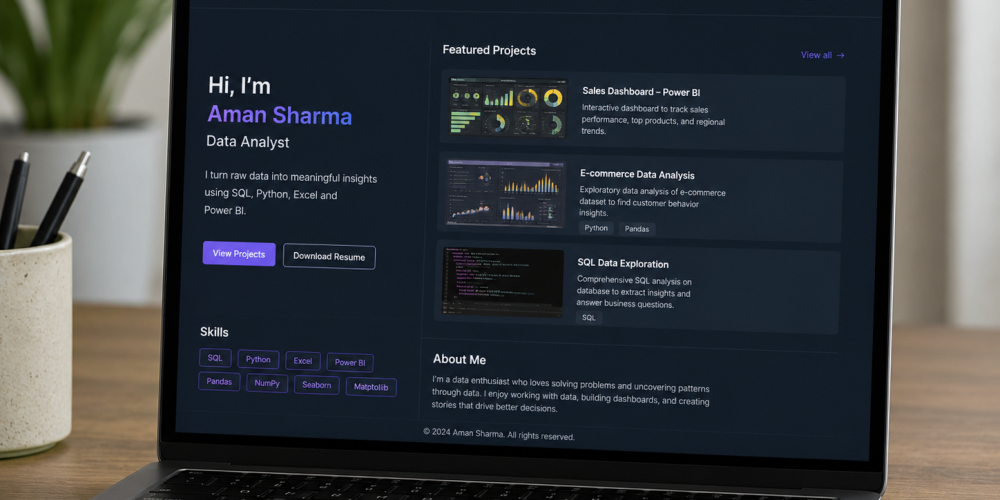
Most hiring managers decide within 60 seconds whether a candidate is worth calling. If you do not have a degree from a top college or years of experience, your data analytics portfolio is your 60 seconds. It is the one thing that can make a recruiter stop scrolling and pick up the phone.
Here is the good news: you do not need a job to build a portfolio. You do not need expensive tools, a computer science background, or a fancy certification. You need curiosity, a dataset, and the willingness to show your thinking.
This blog is your practical guide to building a data analytics portfolio from scratch, whether you are a college student, a fresher applying to jobs, a working professional switching careers, or someone completely new to this field. By the time you finish reading, you will know exactly what to include, what projects to build, and how to present your work so it speaks for itself.
The difference between candidates who get interviews and those who do not is almost always this: one group has a portfolio, and the other does not. Let us make sure you are in the right group.
What a Strong Data Analytics Portfolio Actually Looks Like
Before you build anything, it helps to know what you are building toward. A strong data analytics portfolio is not a list of tools you have learned. It is a collection of real problems you have solved using data.
Think of it the way a photographer thinks about their portfolio. A photographer does not show you a list of cameras they have used. They show you the photos. Your portfolio works the same way. You show the problem, your approach, the tools you used, and what you found. That is it.
A good build data analytics portfolio setup has three to five projects. Not ten. Not one. Three to five, each focused on a different type of analysis or a different domain. Quality matters far more than quantity. A single well-documented project that walks the reader through your thinking is worth ten rushed dashboards with no context.
Each project should answer four questions clearly: What problem were you solving? What data did you use? What tools and methods did you apply? What did you find and why does it matter? When you can answer all four clearly, you have a project worth showing.
Can you Become Data Analyst in 3 Months – Check This
Students who complete a data analytics course in Coimbatore build their first real project as part of their training. Starting with guidance helps you avoid the most common beginner mistake, which is spending weeks on the wrong things and ending up with something that does not showcase your actual skills.
Where to Find Data for Your Portfolio Projects
This is the question almost every beginner gets stuck on. The answer is that free, high-quality data is everywhere. You just need to know where to look.
Kaggle is the most popular starting point for data analytics projects for portfolio work. It has thousands of real datasets across every industry you can think of, from e-commerce to healthcare to sports. Many datasets on Kaggle come with context about what the data represents, which makes it easier to frame your project as a real business problem.
The Indian government’s open data platform at data.gov.in has datasets specific to India, covering areas like agriculture, education, transport, and public health. If you want to build projects with a local angle relevant to Tamil Nadu or Coimbatore, this is a goldmine that most beginners overlook completely.
Google Dataset Search is another underused tool. Type in any topic and it surfaces publicly available datasets from universities, research organisations, and government bodies. For working professionals switching into data analytics, this is especially useful because you can search for data from your own industry and build projects that show domain knowledge directly.
One practical tip: do not spend more than a day picking a dataset. Many beginners lose weeks searching for the perfect one. Pick something that genuinely interests you, frame a clear question, and start.
What Makes a Dataset Portfolio-Ready?
A good dataset for an entry level data analyst portfolio has enough rows to be interesting but is not so large that your laptop struggles with it. Between 500 and 50,000 rows is a comfortable range for most beginner projects. It should also have a mix of numerical and categorical columns, because that gives you more to work with when it comes to visualisation and storytelling.
Five Data Analytics Project Ideas That Actually Impress Hiring Managers
Here are five project ideas that work well for a data analytics portfolio at the beginner to intermediate level. Each one is grounded in a real business scenario, which is exactly what hiring managers want to see.
Sales trend analysis for a retail business. Pick a retail sales dataset and analyse monthly or quarterly trends. Which products sell best in which seasons? Which regions underperform? Build a Power BI or Tableau dashboard that tells the story visually. This is directly relevant to industries across Tamil Nadu, from textiles to FMCG.
Customer churn analysis. Many companies lose customers without understanding why. Find a telecom or subscription dataset and explore what factors predict drop-off. This project shows you can connect data to a business decision, which is exactly what companies pay analysts to do.
HR attrition dashboard. Why do employees leave? An HR dataset covering salary, tenure, and job satisfaction can reveal patterns that every organisation finds useful. It also shows empathy alongside analysis, which hiring managers notice.
COVID-19 or public health data analysis. India-specific public health data tells a rich story. Analyse recovery rates by state, vaccination progress, or hospital capacity trends. This project shows your ability to work with large, real-world data and make it understandable for any audience.
Personal finance tracker and analysis. Build a simple Excel or Python-based tracker that analyses spending patterns from sample data. Flag overspending months and visualise category trends. This one is especially good for freshers because it is relatable and easy to explain in an interview.
Each of these data analytics projects for portfolio use starts with a real question a business would actually want answered. That is what separates a portfolio project from a homework assignment.
How to Present and Share Your Portfolio
Building great projects is only half the work. The other half is making sure people can find them and understand them quickly.
GitHub is the most widely used platform for sharing entry level data analyst portfolio work. Create a free account, upload your project files, and write a clear README for each one. The README should explain the problem, the data source, the tools you used, and your key findings in plain language. Think of it as explaining your work to a smart friend who knows nothing about data.
If GitHub feels overwhelming, a Google Drive folder works just as well. Organise your files neatly, name them clearly, and share the link in your resume and LinkedIn profile.
LinkedIn itself is an underrated portfolio tool. Post about your projects as you build them. Write a short post explaining what you analysed and what surprised you. These posts get solid engagement, and they signal to recruiters that you are actively producing work. Several students from data analytics courses in Coimbatore have landed interview calls this way.
When interviews come, walk through at least one project in detail. Why this dataset? Why this visualisation? What would you do differently? Hiring managers want to know you understand your own work, not just that you completed it.
Building a data analytics portfolio is one of the most valuable things you can do for your career right now. It proves your skills in a way that a certificate alone never can. It gives you something concrete to talk about in every interview. And it shows employers that you are the kind of person who does not wait for permission to start.
Begin with one project. Pick a dataset that interests you, ask a clear question, and use the tools you know. Document your process honestly and share it. Then do the next one.
That is exactly how you go from zero to hero. The market in Tamil Nadu is ready for trained data analytics professionals. Your portfolio is exactly what shows them you are ready.
Is a Data Analytics Course the Right Step After My Degree?
Ready to take the next step in your career? Now that you know exactly how to build a data analytics portfolio that gets noticed, it is time to get the training that makes it all click. At Venster School, Coimbatore’s trusted training institute, we offer a comprehensive data analytics programme with hands-on projects, portfolio guidance, and interview preparation built right into the course. Register for a free demo class today and see how Venster helps you go from beginner to job-ready.