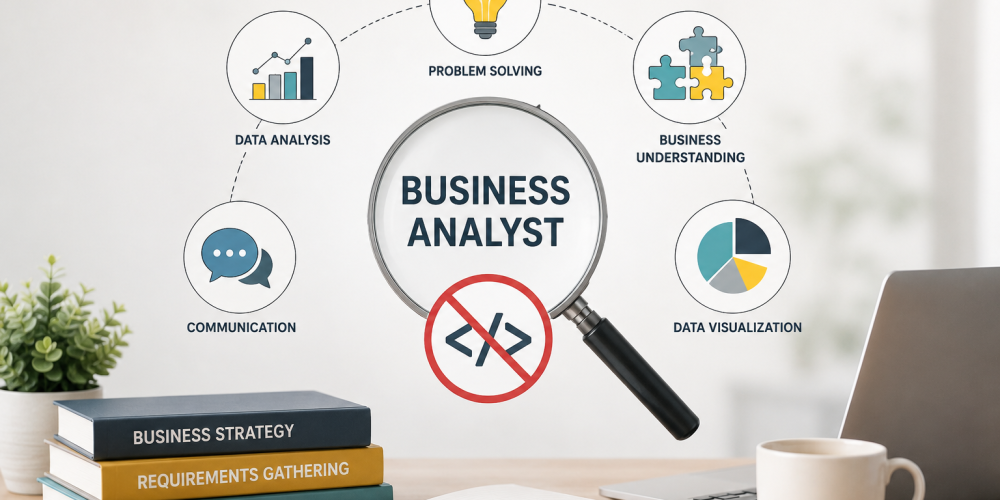
Somewhere between wanting the job and joining a course, one fear stops thousands of would-be analysts every year. I cannot code, so this field is not for me. If that thought has crossed your mind while researching a business analyst course, this article was written for you, and it starts with the answer you are hoping to hear, backed by the honest details behind it. The business analyst role was never built on programming. It was built on understanding problems, and the tools you use for that are ones a complete beginner can learn from scratch. Let us take the fear apart piece by piece.
Coding for Business Analysts, Here’s the Honest Answer
Do I need to learn coding to become a business analyst?” It’s one of the most common fears freshers have before even starting their journey, and it stops many capable people from even considering the role.
Here’s the honest answer: coding can help, but it isn’t mandatory. Most business analyst roles focus on skills like requirements gathering, stakeholder communication, and using tools like Excel, SQL basics, and Power BI, not writing complex code.
In this blog, we’ll break down exactly what a business analyst course really teaches, where coding fits in (if at all), and how you can succeed in this career even without a technical background.
Is Coding Required for a Business Analyst Course?
The short answer is no, coding is not a requirement for a business analyst course. Most courses are designed for people from non-technical backgrounds, including commerce, arts, and management graduates, so they don’t assume prior programming knowledge.
That said, it helps to understand the difference between “must-have” and “nice-to-have” skills. Must-have skills typically include Excel formulas, basic SQL queries for pulling and analyzing data, and familiarity with BI tools like Power BI or Tableau, all of which are taught step by step in a good business analyst course.
Full programming languages like Python or Java, on the other hand, fall under “nice-to-have.” They can add value if you want to move toward a more technical or data-focused BA role, but they’re not something you need to know before you start, or even by the time you finish the course.
Coding isn’t at the center of a business analyst’s role. Most of the “technical” work involves querying data (SQL) or using no-code/low-code tools like Excel and Power BI, rather than writing full programs in languages like Python or Java. Coding becomes useful only in specific situations, like when a BA works closely with data teams or automates repetitive tasks, but it’s a bonus skill, not a core requirement.
Can Non-Coders Succeed as Business Analysts?
Absolutely, and the numbers back this up. A large percentage of working business analysts come from non-technical backgrounds like commerce, finance, arts, and business administration, not computer science. What sets successful BAs apart isn’t a coding background, it’s how well they understand business problems and communicate solutions.
Skills like analytical thinking, problem-solving, and the ability to ask the right questions matter far more than knowing a programming language. A business analyst who can break down a complex process, spot the gap causing inefficiency, and explain it clearly to both a client and a developer is far more valuable than one who can code but struggles to communicate. If you’re a fresher worried about not having a technical background, that’s not a disadvantage, it’s simply a different starting point, and one that a good business analyst course is built to support.
Tools You’ll Learn in a Business Analyst Course (No Coding Required)
A good business analyst course focuses on practical, industry-relevant tools, not programming languages. Here’s what you’ll typically learn:
Excel: Advanced formulas, pivot tables, and data analysis for everyday reporting and decision-making
SQL basics: Simple queries to pull, filter, and analyze data directly from databases, no coding background needed
Power BI / Tableau: Building dashboards and visualizations to present insights clearly to stakeholders
JIRA: Tracking project tasks, user stories, and workflows in agile teams
Visio / Draw.io: Creating process flow diagrams and workflow maps to document business processes
Every one of these tools is designed to be learned step by step, with hands-on practice, regardless of your educational background. You don’t need to know how to code to become confident using any of them, you just need consistent practice and the right guidance.
You Don’t Need to Code to Become a Business Analyst
So, do you need coding for a business analyst course? No, not to get started, and not even to succeed. What matters far more is your ability to understand business problems, communicate clearly, and think analytically, skills that any dedicated learner can build with the right guidance.
If you’re still unsure whether this career path is right for you, that’s completely normal. At Venster School of Excellence, you’re welcome to sit in on a free demo class and see for yourself what the learning experience actually feels like, no pressure, just clarity.
Frequently Asked Questions
Do I need to know coding before joining a business analyst course?
No prior coding is needed. Business analyst courses teach every required tool from scratch, including Excel, basic SQL, and dashboard software like Power BI. These are tool skills rather than programming. Students from commerce, arts, and non IT backgrounds regularly complete these courses and get placed successfully.
Is SQL considered coding for business analysts?
SQL looks like code but works differently in practice. Analysts use it at query level, meaning structured questions asked to a database, such as retrieving sales by region. A few common patterns cover most analyst work, and beginners typically become comfortable within weeks. It is not software development.
Can commerce students become business analysts?
Yes, commerce students are among the best suited candidates. They already understand business operations, budgets, and reporting, which is the core context of analyst work. A business analyst course adds the tool layer, including Excel, SQL, and dashboards, on top of business knowledge they already possess.
What tools does a business analyst use daily?
The daily toolkit includes Excel for analysis, SQL for pulling data, Power BI or Tableau for dashboards, and documentation tools for process maps, requirements, and user stories. Communication platforms and presentation software round out the list. None of these tools involve writing software or programming.
Do business analysts need to learn Python?
Not to start. Python is an optional growth skill that helps in a minority of analytics heavy roles, usually valuable from the second or third year of a career. Entry level business analyst positions test Excel, SQL, communication, and documentation. Treat Python modules in any course as a bonus.
Is maths required for a business analyst course?
Only working numeracy is required, meaning comfort with percentages, averages, and reading charts. Engineering level mathematics never enters typical analyst work. If you can manage a budget and question whether a number looks right, you have the mathematical foundation the course and the role demand.
How long does a business analyst course take to complete?
Most job focused programs run three to six months depending on batch schedule. The timeline includes tool training, practice projects, and interview preparation. Courses shorter than this usually skip the project work that placements depend on, so slightly longer programs with hands-on practice deliver better outcomes.
What is the difference between a business analyst and a data analyst on coding?
Data analysts spend more time inside datasets, so their SQL runs deeper and Python appears more often in their job postings. Business analysts focus on requirements, stakeholders, and processes, keeping technical demands lighter. Both roles remain accessible to non coders, but business analysis leans furthest toward communication.
Can I get a business analyst job without an IT degree?
Yes, and it happens routinely. Employers hiring business analysts screen for tool skills, business understanding, and communication rather than degree titles. Commerce, BBA, arts, and science graduates get placed regularly after structured training with portfolio projects. Your degree matters far less than your demonstrated skills.
Which is the best business analyst course in Coimbatore with placement?
Compare institutes on from-scratch teaching for non coders, hands-on projects, trainer experience, and verifiable placement support rather than advertisements. Venster School of Excellence builds its course for students without technical backgrounds and encourages you to verify this by speaking directly with placed alumni before enrolling.
Do I need to know coding before joining a business analyst course?
No prior coding is needed. Business analyst courses teach every required tool from scratch, including Excel, basic SQL, and dashboard software like Power BI. These are tool skills rather than programming. Students from commerce, arts, and non IT backgrounds regularly complete these courses and get placed successfully.
Is SQL considered coding for business analysts?
SQL looks like code but works differently in practice. Analysts use it at query level, meaning structured questions asked to a database, such as retrieving sales by region. A few common patterns cover most analyst work, and beginners typically become comfortable within weeks. It is not software development.
Can commerce students become business analysts?
Yes, commerce students are among the best suited candidates. They already understand business operations, budgets, and reporting, which is the core context of analyst work. A business analyst course adds the tool layer, including Excel, SQL, and dashboards, on top of business knowledge they already possess.
What tools does a business analyst use daily?
The daily toolkit includes Excel for analysis, SQL for pulling data, Power BI or Tableau for dashboards, and documentation tools for process maps, requirements, and user stories. Communication platforms and presentation software round out the list. None of these tools involve writing software or programming.
Do business analysts need to learn Python?
Not to start. Python is an optional growth skill that helps in a minority of analytics heavy roles, usually valuable from the second or third year of a career. Entry level business analyst positions test Excel, SQL, communication, and documentation. Treat Python modules in any course as a bonus.
Is maths required for a business analyst course?
Only working numeracy is required, meaning comfort with percentages, averages, and reading charts. Engineering level mathematics never enters typical analyst work. If you can manage a budget and question whether a number looks right, you have the mathematical foundation the course and the role demand.
How long does a business analyst course take to complete?
Most job focused programs run three to six months depending on batch schedule. The timeline includes tool training, practice projects, and interview preparation. Courses shorter than this usually skip the project work that placements depend on, so slightly longer programs with hands-on practice deliver better outcomes.
What is the difference between a business analyst and a data analyst on coding?
Data analysts spend more time inside datasets, so their SQL runs deeper and Python appears more often in their job postings. Business analysts focus on requirements, stakeholders, and processes, keeping technical demands lighter. Both roles remain accessible to non coders, but business analysis leans furthest toward communication.
Can I get a business analyst job without an IT degree?
Yes, and it happens routinely. Employers hiring business analysts screen for tool skills, business understanding, and communication rather than degree titles. Commerce, BBA, arts, and science graduates get placed regularly after structured training with portfolio projects. Your degree matters far less than your demonstrated skills.
Which is the best business analyst course in Coimbatore with placement?
Compare institutes on from-scratch teaching for non coders, hands-on projects, trainer experience, and verifiable placement support rather than advertisements. Venster School of Excellence builds its course for students without technical backgrounds and encourages you to verify this by speaking directly with placed alumni before enrolling.