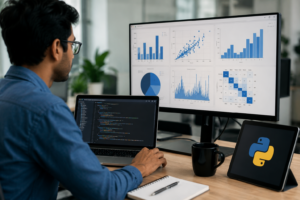
Every business today sits on a goldmine of data. Sales figures, customer behaviour, website traffic, market trends, competitor moves. The companies growing fastest in 2026 are not the ones with the most data. They are the ones who know how to read it. That is exactly where Business Analytics comes in.
Whether you are a working professional looking to level up your value at work, or someone seriously considering a switch into a more future-proof field, understanding how analytics drives real decisions is one of the smartest investments you can make right now. Data is no longer just the concern of IT teams or data scientists. It belongs to every professional who wants to solve problems faster, lead with confidence, and make decisions that actually hold up under scrutiny.
This guide explains why Business Analytics matters more than ever in 2026, walks through real examples of how companies are using it today, shows how it applies to small businesses, covers the core skills professionals need, and gives you a clear path to getting started. By the end, you will have a confident understanding of what this field offers and why now is exactly the right moment to explore it.
What Business Analytics Really Means in 2026
Let’s clear up the biggest misconception first. Business Analytics is not a niche technical skill reserved only for statisticians or software engineers. It is not exclusive to large corporations with dedicated data teams.
Business Analytics is the discipline of using data to understand what is happening inside a business, figure out why it is happening, and decide what to do next. It operates across four levels. Descriptive analytics covers what happened. Diagnostic analytics explores why it happened. Predictive analytics estimates what is likely to happen next. Prescriptive analytics recommends what you should do about it. Each layer adds more intelligence to every decision a business makes.
In 2026, the tools that power Business Analytics have become more accessible than at any previous point. Platforms like Power BI, Tableau, Google Looker Studio, and even advanced Excel features now allow professionals without any coding background to build dashboards, track performance trends, and generate reports that directly shape strategy. You do not need to write algorithms to benefit from analytics. You need to know how to ask the right questions of your data.
Here is a reality that more and more professionals across Coimbatore and Tamil Nadu are beginning to understand: analytics is not a job title. It is a way of thinking. And that way of thinking, once developed, changes how you approach every professional challenge in every industry.
Real World Business Analytics Case Studies That Prove the Point
The power of analytics becomes most visible through results. Here are some Real World Business Analytics Case Studies that show what becomes possible when data actually drives decisions.
Amazon is the most referenced example for a reason. The company’s recommendation engine, built entirely on customer behaviour analytics, accounts for roughly 35% of total annual revenue. Every time a shopper sees “customers also bought,” that is Business Analytics converting browsing into purchasing, at scale, automatically. But the impact of analytics is not limited to companies of that size.
Swiggy and Zomato, two platforms most working professionals across Tamil Nadu use regularly, rely on analytics to predict demand surges by neighbourhood and time of day, optimise delivery routes in real time, and serve personalised discounts at exactly the moment a customer is most likely to order. Their analytics teams process thousands of variables simultaneously to keep costs lean and customer satisfaction high.
A closer-to-home example: a mid-sized garments manufacturer in Tirupur used basic sales analytics to identify that 65% of revenue was coming from just three product categories out of eighteen. They redirected their marketing investment and production capacity toward those three lines and grew annual revenue by over 30% in one year, without launching a single new product or hiring additional staff.
These Real World Business Analytics Case Studies all point to the same truth: analytics is not about complexity. It is about clarity. The ability to cut through the daily noise of operations and find the one signal that actually matters for growth. Whether you work in a startup, a mid-sized firm, or a large enterprise, that clarity is available to any professional who builds the right skills.
How Business Analytics for Small Businesses Changes the Game
One of the most persistent myths about analytics is that it is too expensive or too technical for smaller organisations. In 2026, that argument simply does not hold.
Business Analytics for Small Businesses is more accessible now than at any point in history. Google Looker Studio is completely free. Power BI has an affordable entry tier used by millions of small organisations globally. Excel, which most small business owners already use daily, is capable of surprisingly powerful analysis when approached with the right structure and intent. The real barrier is not cost. It is knowledge.
A small bakery in Coimbatore tracking daily sales in a spreadsheet already has the raw material for analytics. With the right skills, the owner could identify which items sell fastest on which days of the week, which customer segments return most frequently, and which promotions are genuinely converting into purchases versus just generating social media engagement. Every one of those insights is hiding in data that already exists.
The same logic applies to a freelance marketing consultant tracking client campaign performance, a retail store owner monitoring inventory turnover, or a logistics coordinator watching delivery timelines. Business Analytics for Small Businesses is not a premium feature reserved for organisations with large budgets. It is a competitive advantage that is now within reach of anyone with a laptop, a dataset, and the willingness to learn how to read it.
For working professionals and career switchers who want to bring measurable, visible value to their employers or clients, the ability to apply analytics thinking at any business scale is one of the most immediately practical skills available today.
Key Skills Working Professionals Need to Practise Business Analytics
If you are a working professional or someone planning to switch into an analytics-focused role, the core skill set is far more learnable than most people expect. You do not need a computer science degree or years of prior technical experience to get started and get good.
Data visualisation is the ability to present complex data in a way that any stakeholder can understand at a glance. Power BI and Tableau are the industry standard tools for this. If you can build a dashboard that tells a clear, compelling business story without anyone needing to open a single spreadsheet, you are already ahead of most candidates in most rooms.
Statistical thinking does not mean mastering advanced mathematics. It means understanding trends, averages, outliers, and correlations well enough to know when something in your data is genuinely significant versus when it is just random variation. This is as much a mindset shift as a technical one, and it is one of the most transferable capabilities you can develop regardless of which industry you are in.
SQL basics give you the ability to pull exactly the data you need from a database without relying on someone else to extract it for you. Most working professionals can build practical SQL skills in three to four focused weeks, and those skills immediately increase their independence and usefulness in any analytics role.
Business acumen ties everything together. Knowing which metrics actually drive results for a specific business model, understanding how different departments use data for different purposes, and translating numbers into clear recommendations that a non-technical audience can act on. That combination is rare. And it is exactly what separates a capable analyst from one who genuinely influences the direction of a business.
Business Analytics for Business Growth: Where Professionals Should Start
Understanding the value of analytics is one thing. Building the confidence to actually start is another. Here is a clear, practical path forward for working professionals and career switchers in 2026.
Start with one tool and commit to it properly. Choose Power BI or Google Looker Studio and spend three to four weeks building something real with it before moving on to anything else. Start with a personal project, even a simple dashboard built from publicly available data, and focus on understanding what the tool can show you rather than how to make it look impressive.
Follow that with real-world context. Search for Real World Business Analytics Case Studies in your own industry. Study what questions industry leaders are trying to answer, which metrics they track, and what decisions their data informs. This builds the business thinking that no tutorial alone can teach you, and it shows you exactly where to apply the skills you are building.
Then invest in structured learning. A recognised certification in Business Analytics gives you the vocabulary, the frameworks, and the professional credibility that self-study alone cannot fully provide. It tells any employer that your skills have been formally assessed and verified, not just self-declared on a resume.
This is where Business Analytics for business growth becomes personal: when you apply the same discipline that companies use to scale their revenues to scaling your own career. Professionals with strong analytics skills consistently rank among the most sought-after and highest-earning candidates across every industry in India and globally. That is not a coincidence. It is the market responding to a skill that genuinely moves outcomes.
Data is not a passing trend. In 2026, it is only becoming more central to how businesses in Coimbatore, Chennai, and across Tamil Nadu make decisions that actually move the needle.
Business Analytics is not something to observe from a distance while waiting for the right moment. It is a foundational capability for any professional who wants to stay relevant, grow their income, and lead with genuine confidence in the years ahead. Working professionals who build this skill now will find more opportunities opening. Career switchers who invest in it will find the transition genuinely rewarding, both professionally and financially.
The best time to start was a few years ago. The next best time is today. And the professionals who act on that now will be the ones who look back in two years grateful that they did.
Ready to take the next step in your career? Now that you understand why Business Analytics is one of the most valuable skills a professional can build in 2026, it is time to start learning it the right way. At Venster School of Excellence, Coimbatore’s trusted training institute, we offer practical Business Analytics courses designed to take working professionals and career switchers from where they are now to where they want to be, with real tools, real projects, and real support. Book a free demo class at Venster today and let’s build your career together.