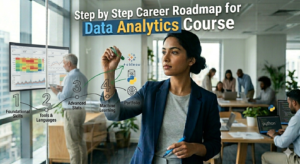
Discover how a practical Data Analytics course equips you with real-world skills and placement support to kickstart your career.
-
- Many aspirants study data analytics online but fail to gain hands-on experience or industry-ready skills. They may know individual tools, yet they struggle to connect them together to solve an actual business problem in a practical environment.
-
- Without practical training, months of learning can go to waste, leaving you frustrated and underprepared for interviews.
-
- This blog reveals exactly what you will learn in a structured, project-based course, including tools, techniques, and placement guidance that ensure you’re ready to excel.
Are You Ready to Become a Data Analyst?
Data analytics is no longer just a buzzword, it’s the backbone of informed decision-making in businesses worldwide. Yet, many aspiring professionals struggle to find a training program that truly equips them with the skills employers demand. Without the right guidance, students often waste months learning theory that doesn’t translate to real-world applications.
Instead of memorizing formulas, you will start working with real datasets that businesses actually use. You learn how raw data looks, how messy it can be, and how analysts transform it into meaningful insights. This shifts your mindset from theoretical learning to practical understanding.
During the training, each module connects to the next so you understand the full analytics workflow from data collection to dashboard presentation. By the end of the program, you will not only know the tools but also when to use them and how to explain your findings clearly, making you ready for interviews and real workplace tasks.
-
- Fresh graduates aiming to become data analysts
-
- Professionals looking to upskill for career growth
-
- Anyone seeking a Data Analytics course with placement in Coimbatore
Your Learning Roadmap
Here’s a quick overview of what you’ll discover in this blog:
-
- Core concepts of data analytics you need to master
-
- Practical problem-solving techniques that employers value
-
- Career prep strategies for interviews and assessments
-
- Common myths and mistakes to avoid
-
- Key takeaways that accelerate your journey to becoming a data analyst
Core Concepts You’ll Master
1. Data Collection & Cleaning
Data collection and cleaning is the first and most crucial step in analytics. It involves gathering both structured data, like spreadsheets and databases, and unstructured data, such as text files or social media inputs. Once collected, this data must be cleaned, which includes removing duplicates, correcting errors, handling missing values, and standardizing formats so it is ready for analysis.
Poor-quality data can lead to misleading conclusions and wrong business decisions. If errors, inconsistencies, or incomplete data are ignored, all subsequent analyses, reports, and visualizations become unreliable. Companies depend on accurate data to make critical decisions, so mastering this step is essential for any aspiring data analyst. In Venster’s Data Analytics course, you learn to clean, validate, and organize real-world data so your analysis is accurate, reliable, and ready for actionable insights.
2.Data Visualization & Reporting
Data visualization and reporting is the process of converting raw data into a clear, visual format that is easy for stakeholders to understand. This includes creating charts, graphs, dashboards, and interactive reports that highlight trends, anomalies, and key insights.
A data analyst’s findings are only valuable if they can be communicated effectively. Poor visualization or unclear reporting can cause confusion, misinterpretation, and even costly mistakes in business decisions. Effective visualization ensures that insights are accessible and actionable.
In the course, you learn tools such as Tableau, Power BI, and Excel to create impactful visualizations. You practice designing dashboards that present insights clearly, making complex data simple to understand. This skill allows you to communicate your analyses confidently to management and stakeholders.
3.Statistical Analysis & Predictive Modeling
Statistical analysis involves examining data to uncover patterns, trends, and relationships, while predictive modeling uses historical data to forecast future outcomes. Techniques include regression analysis, hypothesis testing, clustering, and other statistical methods.
Businesses benefit greatly from predictive insights because they can make proactive decisions rather than reacting to problems. Understanding patterns in data allows companies to optimize marketing campaigns, forecast sales, and plan strategies effectively.
Through hands-on projects using real datasets, you learn to interpret patterns, identify trends, and build predictive models confidently. By applying statistical techniques to practical scenarios, you develop the ability to provide actionable business insights that have measurable impact.
4.SQL & Database Management
SQL and database management involves extracting, storing, and organizing data in relational databases. SQL allows you to query databases efficiently, filter data, and retrieve specific information from large datasets.
Almost every business relies on structured data stored in databases. Without the ability to query and manage these databases, an analyst cannot access the information necessary to drive insights.
The course equips you with mastery over SQL, enabling you to write queries, join tables, filter data, and extract insights on demand. This ensures that you can handle real business datasets effectively, making your analytics work accurate and timely.
5.Excel & Python for Data Analytics
Excel is used for quick analysis, calculations, and data visualization, while Python is a programming language for advanced data manipulation, automation, and predictive modeling. Together, they provide a complete toolkit for data analysis.
Excel is ideal for small to medium datasets and for performing quick business analyses. Python is essential for handling large datasets, automating repetitive tasks, and performing complex analytics, including machine learning models.
In our course, you practice exercises that combine Excel and Python for end-to-end analytics solutions. From cleaning and exploring data in Excel to performing advanced analysis and creating models in Python, you gain the skills to solve practical business problems efficiently. This dual approach ensures you are versatile and job-ready.
How the Course Addresses Real World Challenges?
-
- Many students finish a data analytics course but struggle to use their knowledge in real business situations. They may understand statistics, visualization, and SQL separately, yet find it hard to combine them to solve practical problems. Because of this gap, working with company datasets, answering real business questions, and making data driven decisions becomes challenging.
-
- Without hands-on experience, even the most knowledgeable students can feel overwhelmed during interviews, live projects, or assessments. They may know the tools but fail to use them in a way that produces actionable insights. This lack of practical exposure can lead to frustration, lost opportunities, and difficulty in convincing employers that they are truly job-ready.
-
- Venster School of Excellence’s data analytics training in Coimbatore focuses on project-based learning with real datasets and live case studies. Students practice cleaning data, analyzing trends, building dashboards, and presenting insights. This hands-on approach builds confidence and job-ready skills employers expect.
Before the course, students might know formulas but can’t interpret sales data trends. After completing projects, they confidently produce dashboards that influence real decision-making.
Career Preparation: Stand Out in Interviews
Simply knowing data analytics concepts and tools is not enough to secure a job. In the professional world, the ability to communicate insights clearly and confidently is just as important as technical expertise. Employers want candidates who can explain their analysis, justify decisions, and translate complex data into actionable business recommendations.
Unfortunately, many candidates struggle with this skill. They may perform well in technical assessments but fail to impress during interviews because they cannot present their findings effectively or link their work to real business outcomes. This gap often leads to missed opportunities, even for students who have strong analytical skills.
Venster School teaches you:
-
- How to answer technical questions with clarity
-
- Frameworks for case-study-based assessments
-
- Resume and portfolio guidance for opportunities
This ensures you’re not only skilled but also market-ready.
Common Myths & Mistakes in Data Analytics
-
- Myth: “You must know coding extensively.”
Reality: Core analytics can be mastered with SQL, Python basics, and Excel.
- Myth: “You must know coding extensively.”
-
- Myth: “Certification alone guarantees a job.”
Reality: Hands-on experience and placement support matter far more than just certificates.
- Myth: “Certification alone guarantees a job.”
Mistake: Ignoring real-world projects.
Solution: Venster School emphasizes applied learning through live projects and internships.
Key Takeaways
-
- Master the end-to-end process of collecting, analyzing, and visualizing data
-
- Practice with real-world datasets to gain confidence before entering the job market
-
- Build a strong portfolio and resume to secure placement opportunities
-
- Understand tools like SQL, Python, Excel, and Tableau for versatile analytics
-
- Avoid common misconceptions and accelerate your career growth
After exploring what you actually learn in data analytics training, it’s clear that practical skills, real projects, and tool mastery are what make you job-ready.
If you’re wondering how to bridge the gap between learning and earning, Venster School of Excellence’s Data Analytics Course in Coimbatore might be exactly what you need. This blog dives into what you will actually learn, why it matters, and how the program can position you for career success.
Register for a free demo session and take the leap toward building your career with confidence!
FAQs
1. Do I need prior coding experience?
No, the course is designed for beginners and professionals alike, focusing on practical tools and real-world application.
2. Will I get placement assistance?
Yes, Venster School provides dedicated placement support to help you land your first data analyst role.
3. What is the course duration?
The program duration varies, typically 3–6 months, depending on full-time or part-time schedules.
4. Can I learn while working?
Absolutely! The course is flexible and offers project-based learning suitable for working professionals.
5. Can I become a data analyst without a technical background?
Yes, you can become a data analyst without a technical background. By learning tools like Excel, SQL, Power BI, and basic statistics, beginners can build skills step by step. At Venster School of Excellence, training, projects, and mentorship help non-IT students start a career in data analytics.
6. What are the top skills recruiters look for in data analyst candidates?
Recruiters look for a combination of technical and analytical skills in data analyst candidates. This includes proficiency in SQL, Excel, Power BI, Python, and the ability to clean, analyze, and visualize data. Strong problem-solving, business insight interpretation, and reporting skills are also highly valued.
7. What is the average starting salary expectation for data analysts in Coimbatore?
Entry level data analysts in Coimbatore usually earn about ₹3.5 LPA to ₹6 LPA, based on skills and project experience. Hands-on practice in SQL, Power BI, and Excel with a good portfolio can lead to better offers. Practical training at Venster School of Excellence can further improve salary prospects.
8. Can I become a data analyst with an online course in 3 months?
Yes, you can start a data analyst career in about 3 months with an intensive course that teaches SQL, Excel, Power BI, and real projects. Building a portfolio is important for getting hired. Venster School of Excellence focuses on hands on training, live projects, and placement guidance to help you become job ready quickly.
9. What skills should I learn to become a data analyst quickly?
To become a data analyst quickly, focus on practical, high-demand skills such as:
-
- Data manipulation and querying using SQL
-
- Data analysis and visualization with Excel and Power BI
-
- Basic statistics and data interpretation
-
- Problem-solving and business insight analysis
-
- Documentation and reporting
At Venster School of Excellence, our Data Analytics courses in Coimbatore teaches all these skills through hands-on projects and real-world scenarios, helping you become job-ready faster.
10.Is learning a data analytics course difficult for beginners?
Learning data analytics is not hard for beginners if you follow a structured practical course. At Venster School of Excellence, students start with basics like Excel, SQL, and statistics, then move to real projects with mentorship and placement support to become job ready.