From “Open to Work” to “Hired”: Your Real World Guide to the Data Industry
Stop guessing your career path and start following a proven blueprint designed for the 2026 job market.
The Graduate Struggle: Why Your Degree Isn’t Calling You Back
Let’s be honest for a second. You’ve spent years in college, passed all your exams, and probably have a framed degree on your wall. But when you look at job descriptions for data roles, it feels like they’re written in a different language. You see requirements for SQL, Python, Tableau, and “3 years of experience” for an entry level role. It’s frustrating, right? You have the drive, but you’re stuck behind a door that won’t budge.This is the “Skill Gap” we talk about so often. Colleges teach you the theory, but the industry wants results. If you don’t bridge that gap, you risk falling into the trap of underemployment taking a job that doesn’t challenge you or pay you what you’re worth. If you’ve been looking for a data analytics course in Coimbatore, it’s because you know deep down that you need more than just a certificate. You need a transformation.
Your Roadmap to Success
- Why logic beats coding every single time.
- The tools that actually matter to recruiters in 2026.
- How to build a portfolio that speaks louder than your resume.
- Why a data analytics course is your secret weapon.
- How to handle the pressure and land the offer.
Understanding the Data World
Think about the last time you bought something online. Every click you made, every second you spent looking at a product, and even the items you left in your cart that’s all data. Companies are drowning in this information, but they are starving for people who can make sense of it.
The problem is that most beginners think data analytics is just about “math.” It’s not. It’s about storytelling. It’s about looking at a messy pile of numbers and saying, “Hey, if we change this one thing, we can save the company a million rupees.”This matters because when you join data analytics training in Coimbatore at Venster School of Excellence, we don’t just teach you how to click buttons in Excel. We teach you how to think like a business consultant. Why? Because the person who can explain why the numbers moved is the person who gets promoted.
Master Data Analytics with an Online Course with Certificate Through Real World Projects
The “Tutorial Trap”
You watch a YouTube video, you follow the steps, and you feel like a genius. But then, you try to do it on your own and you have no idea where to start. This is the “Tutorial Trap.” You’re mimicking, not learning.
The Cost of Stagnation
Every month you spend “self learning” without a structure is a month of salary you’re leaving on the table. While you’re trying to figure out which Python library to use, someone else is already finishing their first month at a top firm. The tech world moves fast; if you aren’t moving with it, you’re falling behind.
Mentorship and Real-World Projects
A data analytics training online fixes this by giving you skin in the game. You aren’t just watching; you’re doing. You’ll work on live datasets predicting supply chain delays for a local Coimbatore manufacturer or analyzing retail trends. This takes you from “I think I know this” to “I’ve done this before.”
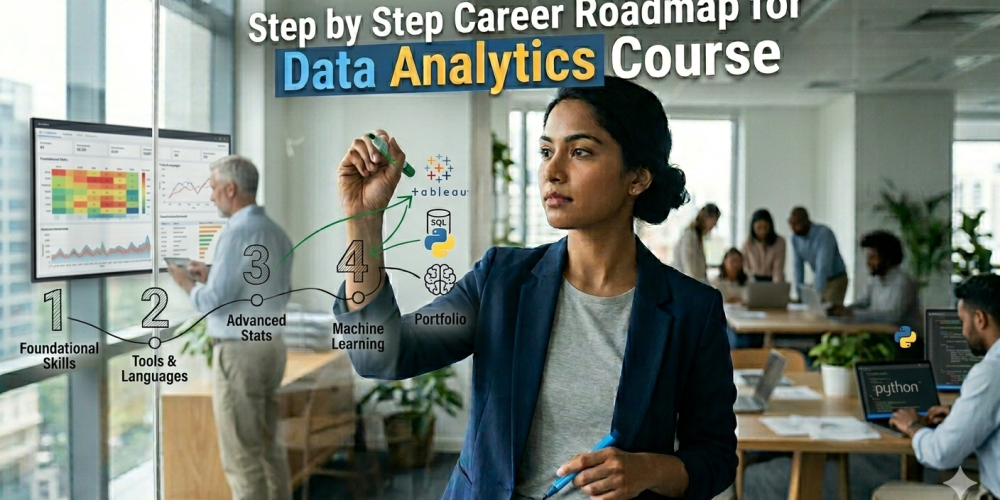
The Roadmap: Your First 120 Days
The Basics
In the first month, we strip everything back. You master Excel (the real kind, not just tables), SQL for talking to databases, and the basics of statistics. This is your foundation. Without it, the fancy AI stuff won’t make sense.
The Visuals
Data is useless if people can’t understand it. You’ll dive into Power BI and Tableau. This is where you learn to create dashboards to work for a real business.
The Code
Now, we introduce Python. But we don’t teach you to build apps; we teach you to analyze data. You’ll learn how to automate boring tasks so you can focus on the big picture insights.
Interview Mastery: Getting You Through the Door
The biggest fear students have is the technical interview. “What if they ask a question I don’t know?” Here’s a secret: Interviewers care more about your process than your answer.
At Venster School of Excellence, we spend a massive amount of time on the “Soft” side of Data Science. We help you build a LinkedIn profile that actually gets views, We remove unnecessary and irrelevant content from your resume to make it clear, concise, and impactful. and we run mock interviews until you can explain a complex SQL join to your grandmother. This is why a data analytics certification with placement is so valuable it’s not just about the code; it’s about the career.
Common Myths That are Holding You Back
Myth 1: “I need to be a math genius.”
Reality: You need to know basic statistics and have good logic. The computer does the heavy math for you.
Myth 2: “AI will replace data analysts.”
Reality: AI is a tool. It can’t replace the human intuition needed to understand why a customer behaves a certain way.
Myth 3: “Only IT students can apply.”
Reality: Some of our most successful students come from Commerce, MBA, and even Arts backgrounds. Diversity in thinking is a huge plus in data.
Key Takeaways: Your Power Moves
- Build a Portfolio: One real project is worth more than ten certificates.
- Learn SQL First: It’s the backbone of the entire industry.
- Network Locally: Coimbatore has a massive industrial base; connect with local HRs.
- Master Communication: If you can’t explain your data, you can’t sell your insights.
Look, you can keep scrolling through job boards, or you can decide to become the candidate that job boards are looking for. The demand for data professionals in Coimbatore is at an all time high, but companies are looking for specific, job ready skills.
By enrolling in abest data analyst course online, you are making an investment in your future self. You are choosing a path of growth, high salaries, and constant learning. At Venster School of Excellence, we don’t just give you a seat in a classroom; we give you a launchpad for your career.Don’t let another month slip by. Join our Live Sessions or book a free demo class today to see how we turn students into professionals. Let’s build your roadmap together.
FAQs:
1. Why should we learn data analytics?
We should learn data analytics because it helps us make better decisions using data instead of assumptions. It improves problem-solving skills, increases career opportunities, and is in high demand across industries. In today’s digital world, data analytics is a valuable and future-ready skill.
2. What are the benefits of studying data analytics?
Studying data analytics offers several key benefits:
- Better decision-making – Helps you make informed decisions based on data, not assumptions.
- High career demand – Data analysts are needed across industries like finance, healthcare, marketing, and IT.
- Strong salary potential – Skilled professionals earn competitive salaries.
- Problem-solving skills – Improves logical thinking and analytical ability.
- Business growth impact – Enables organizations to identify trends, reduce risks, and increase profits.
- Versatile career options – Opens opportunities in roles such as Data Analyst, Business Analyst, and Data Scientist.
3. Why is data analytics so important?
Data analytics is important because it turns raw data into insights, helping businesses make informed decisions, understand customers, reduce risks, and stay competitive in a rapidly changing market. It also drives innovation by uncovering new opportunities for growth.
4. What are the top 3 skills for a data analyst?
The top 3 skills for a data analyst are:
- Data Analysis & Interpretation – Ability to examine data and draw meaningful insights.
- Excel & SQL – Strong skills in data manipulation and querying databases.
- Data Visualization – Presenting data clearly using tools like Power BI or Tableau.
5. Is Python or SQL easier?
SQL is easier for beginners as it handles data queries with simple commands, while Python is more versatile for analysis and automation. For data analysts, it’s best to start with SQL, then learn Python for deeper insights.
6. How do I get my first job without experience?
Get your first job by building practical skills, creating a portfolio with real or sample projects, earning certifications, and applying for internships or entry level roles. Networking and interview preparation also boost your chances.
7. What are the standard steps in a data analysis project?
The standard steps in a data analytics project are:
- Define the Problem – Understand the business question or goal.
- Collect Data – Gather data from relevant sources.
- Clean & Prepare Data – Remove errors, handle missing values, and organize data.
- Analyze Data – Use statistical methods and tools to find patterns and insights.
- Visualize Results – Present findings using charts, dashboards, or reports.
- Make Recommendations – Provide actionable insights for decision-making.
- Review & Iterate – Validate results and refine the analysis if needed.
8. Do you provide 100% data analytics training with placement, and how do you guarantee it?
We offer complete data analytics training with full placement support. While we cannot guarantee a job since hiring depends on performance and market demand we maximize your chances by providing:
- Hands on projects and case studies to build a strong portfolio
- Resume building, mock interviews, and soft skills training
- Connections with industry partners and placement opportunities
- Ongoing guidance and support until you secure a role
9. What tools are essential to learn?
The essential tools to learn for data analytics are:
- Excel – For data cleaning, analysis, and basic visualization.
- SQL – For querying and managing databases.
- Python or R – For advanced data analysis, automation, and modeling.
- Tableau / Power BI – For data visualization and creating dashboards.
- Google Analytics / MS Excel Add-ons – For web and business data tracking (optional but useful).
10. What projects should I put on my resume?
Include projects that show practical skills and problem-solving, such as sales analysis, customer segmentation, dashboards, predictive modeling, and data cleaning. Mention the tools used and the outcomes achieved.