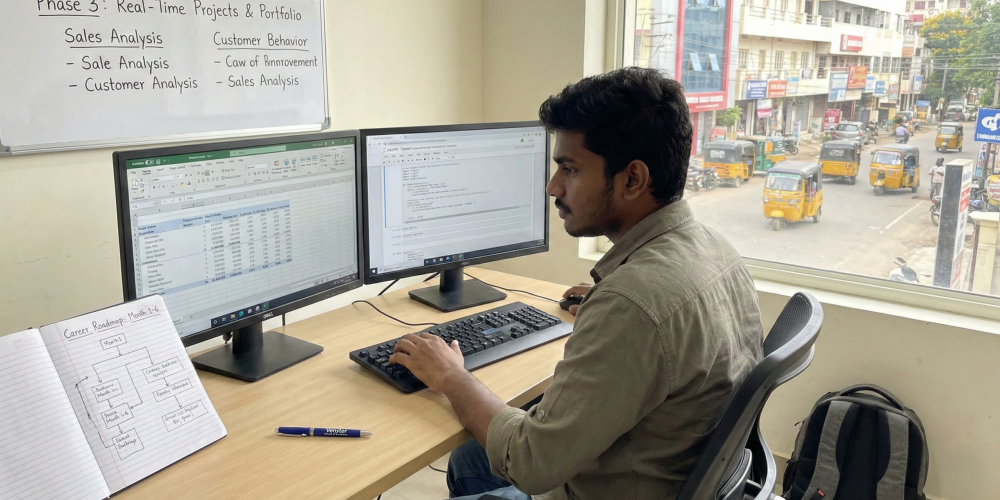
From Beginner to Job-Ready Analyst in 6 Months
You joined a Data Analyst Course in Coimbatore because you wanted a breakthrough in your career.
Maybe you were an unplaced graduate feeling entirely unsure about your future. Perhaps you were stuck in a low-paying, non-IT job, knowing you have the potential to do more but lacking the technical stepping stones. Or maybe you are feeling the heavy pressure from your family to settle into a stable career quickly.
Taking that first step and enrolling is a massive achievement. But almost immediately after joining, a new, very real doubt appears:
“What exactly should I do, step-by-step, to actually get placed?”
This blog gives you a crystal-clear, 6-month roadmap. We are not going to give you empty motivation or vague theory. This is a highly structured, battle-tested career path you can follow from day one all the way to your placement interview.
Attend Our Free Demo Class – No Strings Attached
Now, let’s break down your transformation.
The Typical Beginner Situation Before Training
Most students who enroll in a data analytics training institute in Coimbatore face incredibly similar challenges. You are not alone if you feel overwhelmed by the landscape of data science basics.
Common fears include:
- No Technical Background: You might feel like everyone else in the room already knows how to code.
- Confusion about Tools: The debate between SQL vs. Python vs. R can be paralyzing.
- Fear of Interviews: The thought of a technical whiteboard interview triggers anxiety.
- Portfolio Panic: You have no idea what a portfolio is, let alone how to build one that companies actually care about.
Before finding a structured program, many people randomly learn from YouTube. They fall into “tutorial hell,” jumping between tools, watching hours of video, but never actually applying the knowledge. They learn how to write a line of code, but they completely fail to understand the fundamentals of why they are writing it.
But here is the truth: data analytics is not about collecting certificates. It is about understanding how data flows through systems and how businesses use those insights to make critical, revenue-driving decisions. The difference between perpetual confusion and landing a great job is structure.
The Job-Ready Data Analyst You Become
After 6 months of structured, placement-oriented training, your professional profile will undergo a complete transformation. You will shift from an unsure beginner to a confident professional whose resume commands attention.
Here is what your skill set will look like:
- Advanced Data Manipulation: Confident use of Microsoft Excel for quick analysis, pivot tables, and data modeling.
- Database Management: Confident database querying using SQL, including complex joins and window functions.
- Analytical Programming: Data analysis and automation using Python (specifically libraries like Pandas and NumPy).
- Visual Storytelling: Interactive dashboard creation using Power BI to present complex data to non-technical stakeholders.
- Proven Experience: A robust portfolio filled with real-time projects that solve actual business problems.
- Interview Readiness: A deep understanding of how to answer behavioral and technical interview questions using the STAR method.
Entry-level IT jobs in Coimbatore and across India for data analysts typically range between 3.5 LPA to 6 LPA, heavily depending on your skill level, interview performance, and project experience. Furthermore, with a strong, well-documented portfolio, remote roles for international companies become a very real possibility.
Companies today want problem solvers, not just degree holders. This roadmap builds that exact capability, step-by-step.
The 6-Month Data Analytics Career Roadmap
If you want to become a successful data analyst, you cannot skip steps. You must build a foundation before you build the house. Here is exactly how your 6 months will look.
Phase 1 – Month 1: Foundation and Clarity
The Goal: Remove the fear of data. You should feel comfortable opening massive datasets and exploring them without confusion or anxiety.
Month 1 is all about breaking the ice. We do not throw you into complex coding right away. Instead, you will focus on mastering the tool that 99% of businesses still use every single day: Excel. Furthermore, you will be introduced to the foundational concepts of databases.
Key Focus Areas:
- Advanced Excel: Moving beyond basic sums to master VLOOKUP, XLOOKUP, Index/Match, Pivot Tables, and interactive dashboard creation.
- Data Cleaning Basics: Learning how to identify missing values, remove duplicates, and format data so it is ready for analysis.
- Database Introduction: Understanding how relational databases work, primary keys, foreign keys, and how data is stored in the real world.
- Basic SQL Queries: Writing your first SELECT, FROM, and WHERE statements.
Resource Tip: To understand relational databases better, you can explore documentation like the MySQL Reference Manual.
Phase 2 – Months 2 & 3: Core Technical Skills
The Goal: Develop heavy technical strength. You should be able to convert raw data into actionable insights and present them logically.
This is where the heavy lifting happens. You will transition from basic data viewing to complex data manipulation.
SQL Advanced Mastery: You will move from writing simple queries to solving complex business questions. You will learn:
- Joins: Inner, Outer, Left, and Right joins to combine data from multiple tables.
- Subqueries: Writing queries within queries to isolate specific data points.
- Aggregations & Group By: Summarizing massive datasets to find averages, maximums, and totals.
- Window Functions: Advanced calculations across sets of table rows.
Python for Analytics: Python is the industry standard for data manipulation. You will learn to use Python libraries for:
- Data Cleaning & Transformation: Using the Pandas library to manipulate data far faster than Excel ever could.
- Exploratory Data Analysis (EDA): Finding hidden trends and outliers in your datasets.
- Resource Tip: Official tutorials help strengthen fundamentals. Check out the Python Official Documentation.
Data Visualization with Power BI: Data is useless if you cannot explain it to a manager or CEO. You will start building interactive dashboards that communicate insights clearly.
Phase 3 – Months 4 & 5: Real-Time Projects and Portfolio
The Goal: Prove your worth. By the end of this phase, your portfolio will do the talking for you. This phase entirely decides your placement potential.
Recruiters do not care that you know what a Python dictionary is; they care what you can do with it. In these two months, you will act as a junior data analyst working on real-world business scenarios.
You will work on projects such as:
- Sales Performance Analysis: Identifying seasonal trends and top-performing regional products.
- Customer Behavior & Churn Analysis: Predicting which customers are likely to leave a service and why.
- Supply Chain Dashboard Reporting: Visualizing inventory bottlenecks.
The Art of Documentation: You also learn structured documentation practices. Instead of just saving code on your computer, you will learn to use platforms like GitHub and Jupyter Notebooks to showcase your work.
Your final portfolio will include:
- 3 highly focused mini-projects.
- 1 massive capstone project.
- Clearly documented problem statements.
- A concise “Business Insights” summary for every project.
Recruiters evaluate business impact, not just your ability to memorize tools.
Phase 4 – Month 6: Interview and Placement Strategy
The Goal: Crack the interview and secure the offer.
Now that you have the skills and the portfolio, the final month shifts entirely to placement assistance. Knowing the answer and communicating the answer under pressure are two very different things.
You will aggressively prepare for:
- SQL Problem-Solving Rounds: Live coding tests where you must write queries on the spot.
- Scenario-Based Analytical Questions: “If our sales dropped 10% last month, how would you use data to find out why?”
- Dashboard Explanation Rounds: Walking a mock-interviewer through your Power BI dashboard and defending your design choices.
- HR and Behavioral Questions: Using the STAR (Situation, Task, Action, Result) method to confidently discuss your journey and your projects.
This is where the structured guidance of a dedicated training institute becomes absolutely crucial.
You can explore the Full Data Analytics Course Curriculum here.
Common Blockers and Fixes (The Mindset Shift)
It is completely normal to face mental roadblocks during this 6-month journey. Here is how we help you overcome them:
“I’m not from an IT background.” Data analytics is fundamentally logic-driven, not heavy software development. You do not need to build applications; you need to find answers. Some of the most successful analysts come from commerce, arts, and mechanical engineering backgrounds because they understand how real-world systems work.
“I’m weak in math.” You do not need advanced calculus to be a data analyst. You only need a strong grasp of basic statistics: averages, medians, percentages, standard deviation, and correlation. The software does the heavy mathematical lifting; your job is to interpret the results.
“I learn slowly.” Consistency matters exponentially more than speed. Practicing for one hour every single day is vastly superior to cramming for 10 hours on a Sunday. A 5 to 6-month timeline allows for a steady, manageable absorption of information.
“I’m afraid of interviews.” Confidence is built through repetition. By the time you sit for a real interview, you will have gone through multiple mock interviews and repeated your project explanations so many times that answering questions will feel like second nature.
Why This Specific Roadmap Works
The job market is competitive, but it highly rewards competence. Instead of randomly learning tools in a vacuum, you follow a defined, logical bridge from absolute beginner to job-ready analyst.
This roadmap guarantees:
- Structured progression: You never learn a tool before you understand the concept behind it.
- Skill-based training: Focus on what companies actually test for.
- Real-time projects: You build a resume that proves your competence.
- Interview preparation integration: You learn how to sell your skills to HR and technical leads.
- Placement-oriented focus: The ultimate goal is always employment, not just a certificate.
If you are serious about transforming your career and becoming a data analyst, contact our counselors directly through the course page to understand exactly how our placement guidance works.
Frequently Asked Questions (FAQs)
1. Is this Data Analyst Course in Coimbatore suitable for absolute beginners? Absolutely. The roadmap is designed specifically for beginners. It starts from fundamental Excel concepts and gradually layers on SQL, Python, and visualization skills only when you are ready.
2. How long does it realistically take to become job-ready? With consistent, daily effort and adherence to the roadmap, most learners become placement-ready within 5 to 6 months.
3. Do I need prior coding knowledge to join? No. Languages like Python and SQL are taught entirely from scratch. We assume you have never written a line of code in your life.
4. Will I work on real-time projects? Yes. Portfolio development using practical, real-world datasets is a core, mandatory part of the Phase 3 roadmap. You will not graduate without a portfolio.
5. How does the placement support actually work? Our placement assistance is fully integrated into the program. It includes structured mock interview preparation, resume building, portfolio project guidance, and direct career mentoring to connect you with IT jobs in Coimbatore and beyond.
Take control of your career today. Stop guessing what to learn and start following a proven path.
Register for our free Demo Class online, here.